

We are pleased to announce Lightbits v3.21.1, the newest release on our Standard-Term Support (STS) stream. This release gives operators direct control over how a cluster recovers from hardware and network failures: it introduces Spare Capacity Reservation and Rebuild and Rebalance Throttle Controls, makes server eviction generally available, and brings RHEL 10 to the storage cluster as a Tech Preview. On the core platform, the Kubernetes CSI driver gains security enhancements, the Proxmox VE plugin reaches general availability, and a new Apache CloudStack plugin arrives as an alpha, alongside a broad set of resiliency and monitoring improvements. As a leader in high-performance Software-Defined Storage built on NVMe over TCP block storage, Lightbits continues to deliver a modern, efficient, and scalable data platform for demanding AI inference, cloud service providers, e-commerce, financial services, and enterprise workloads.
Predictable and Even More Resilient Recovery: Spare Capacity Reservation and Rebuild Throttle Controls
Hardware fails and networks break: a server loses power, an SSD wears out, a network card or switch port goes down. When that happens, Lightbits keeps volumes available and rebuilds the affected data on the surviving nodes. Two things decide how smoothly that recovery goes: whether the surviving nodes have room for the rebuilt data, and how much bandwidth the rebuild takes from running applications. v3.21.1 puts both in the operator’s hands.
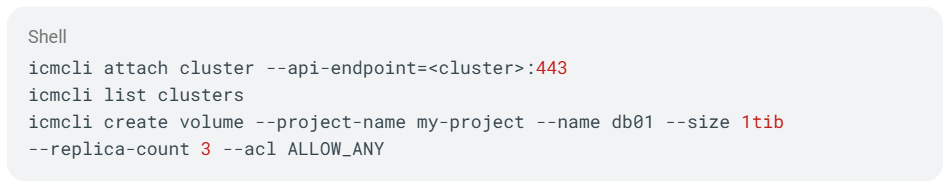
Spare Capacity Reservation is a new cluster-level setting that keeps a configurable percentage of each node’s capacity free (0 to 50%), so the cluster always has room to rebuild after a server or drive failure. Instead of letting the cluster fill to the last byte, writes stop at a line the administrator sets; when a server goes down, lowering the reservation releases that space for the rebuild. Reserving 25% of each node’s capacity takes a single command:

The same setting is available through the REST API. Changes are refused during rebuilds, evictions, migrations, or upgrades, so data-moving operations never change halfway through. Effective capacity, reserved capacity, and the applied percentage are all visible per node in lbcli, in Prometheus metrics, and in the Grafana dashboards. For organizations with strict availability requirements, such as financial institutions, this turns “we should have enough free space to survive a hardware failure” into a guarantee the cluster enforces.
Rebuild and Rebalance Throttle Controls add a cluster-wide setting that caps the bandwidth rebuild and rebalance traffic uses on each node, with separate transmit and receive limits, and lets you choose whether background I/O or user I/O takes priority, or balances the two. Configured once, the setting applies to every node, and concurrent rebuilds or rebalances share their throttle. After a server is replaced or a network link is restored, operators can protect application performance while the cluster catches up during business hours, or remove the limits and let recovery finish as fast as possible during a maintenance window:

Setting a limit to 0 removes it and restores the default, unthrottled behavior, and the same controls are available through the REST API.
Together, these two capabilities make recovery from hardware and network failures more resilient and fully predictable: you set aside space in advance and choose its impact on production workloads, rather than being surprised by it.
Read more: Spare Capacity Reservation · Rebuild and Rebalance Throttle Controls
Server Eviction: Now Generally Available
Server eviction, first introduced as a Technology Preview, is now generally available and officially supported for production use. Evicting a server migrates all of its volumes and snapshots to other servers in the cluster before planned maintenance or removal, keeping volumes fully protected throughout. You can also use it to move data off a server whose nodes have become unavailable, without waiting for them to reach a permanently failed state. For teams running hardware refreshes, firmware updates, or rack moves at scale, eviction turns server maintenance into a routine, non-disruptive operation, and it works hand in hand with the new throttle controls to keep the data movement from competing with production I/O.
Eviction is part of disabling a server. As a deliberate safety measure, it’s enabled per cluster via a feature flag, so data moves off a server only on clusters where an administrator has explicitly opted in. Once it is enabled, a single command moves all of a server’s data to the rest of the cluster and disables the server, and the server’s state shows the progress until the eviction completes:

Read more: Disabling a Server and Evicting Its Data
Kubernetes CSI: IP-ACL and NVMe In-Band Authentication
The Lightbits CSI driver now supports two security capabilities that were already available in the core platform: IP-based access control lists (IP-ACL) and NVMe in-band authentication (DH-HMAC-CHAP). With IP-ACL enabled through a new opt-in StorageClass parameter, the driver manages each volume’s access list on its own, enrolling a worker node’s data-path addresses when a volume is staged on it and resetting the list when the last node detaches, so access follows pods as they move between nodes. With in-band authentication enabled through a single Helm value, each worker node registers itself as a trusted host, the driver automatically generates and maintains its secrets, and every NVMe/TCP connection authenticates; on clusters without in-band authentication, the driver keeps the existing connection flow. Both capabilities are generally available and validated with Lightbits v3.20.1 and v3.21.1, giving security-conscious organizations, such as banks and other regulated enterprises, defense in depth for containerized workloads without adding manual steps to their Kubernetes operations.
Read more: Lightbits CSI Plugin · Lightbits CSI plugin on GitHub · CSI IPACL/Authentication
RHEL 10 for the Storage Cluster: Tech Preview
Following the introduction of Ubuntu 24.04 as a storage cluster operating system in v3.20.1, v3.21.1 adds Tech Preview support for installing the Lightbits storage cluster on Red Hat Enterprise Linux (RHEL) 10. RHEL 10 has been supported on the client side, for hosts connecting to Lightbits volumes over NVMe over TCP, since earlier releases; this Tech Preview extends it to the storage servers themselves. It is intended for evaluation only: we encourage customers planning their move to RHEL 10 to validate and test their workloads with Lightbits deployed on RHEL 10 in non-production environments, and to share their feedback with us as we drive it toward general availability.
Reminder: RHEL 8 and DCPMM. As announced with v3.18.2, the RHEL 8 family (RHEL 8, AlmaLinux 8, Rocky Linux 8) and Intel Optane DC Persistent Memory (DCPMM) are no longer supported on the STS stream starting with v3.20.1, and this applies to v3.21.1 as well. The 3.18.x LTS line is the last to support them, and LTS release lines starting with 3.20.2 will not. To move beyond 3.18.x, clusters need RHEL 9 (or the RHEL 10 family going forward), with SSD journaling replacing DCPMM.
Read more: Modernizing the Platform Foundation (RHEL 8 and DCPMM)
Intelligent Cluster Management v1.0: One Control Plane for the Fleet
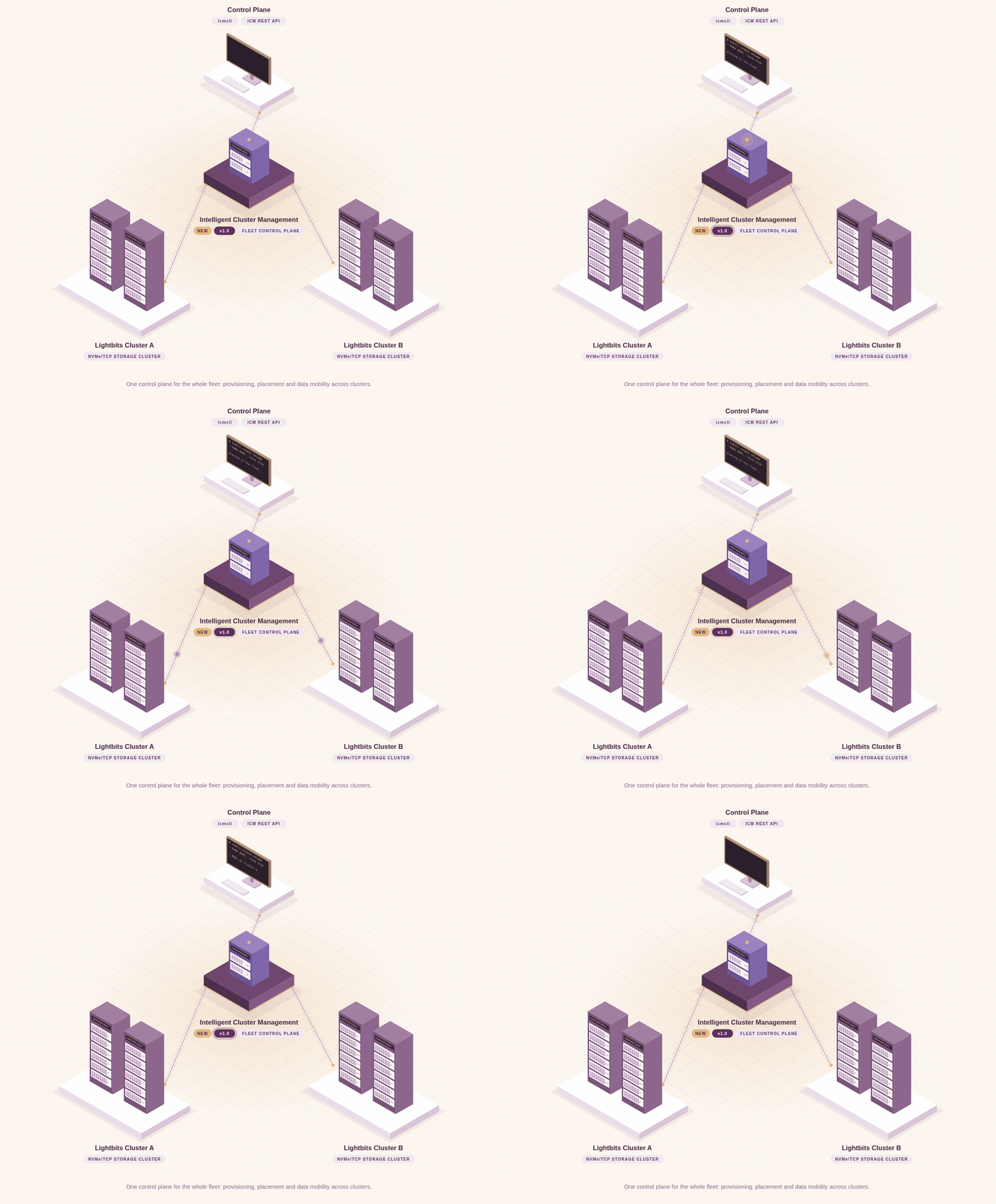
Last December we introduced Intelligent Cluster Management (ICM) as a Tech Preview, a central control plane that turns independent Lightbits clusters into one managed fleet. Alongside v3.21.1, ICM reaches v1.0. ICM runs as a standalone service on its own host, outside the storage clusters, and gives operators and their automation a single API and CLI endpoint for the whole fleet: clusters are attached and detached through ICM, and volumes and snapshots on every attached cluster are created, listed, updated, and deleted through it, with ICM choosing where each new volume lands. Operators work with ICM through icmcli or the ICM REST API, which mirrors the Lightbits v2 API, so existing scripts and automation built on the Lightbits API carry over with little change.
ICM v1.0 also brings together two earlier Lightbits services, Cluster Federation and the Data Mobility Service (DMS). Thick clones of volumes and snapshots, within a cluster or across clusters, now run as ICM workflows that can be tracked and canceled; ICM copies the data over NVMe over TCP, and DMS users keep working through a backward-compatible API with no client code changes.
Read more: ICM Overview · Installing ICM · icmcli reference · ICM API
Platform Ecosystem: Proxmox VE Goes GA, Apache CloudStack Joins the Family
In v3.20.1, we introduced the Proxmox VE plugin as a Tech Preview and promised that another platform integration would follow soon. With v3.21.1, we delivered on both promises.
Proxmox VE plugin is GA, and Lightbits is an official Proxmox Solution Provider. With v3.21.1, the Lightbits Proxmox VE plugin is generally available, and Lightbits is now an official Proxmox Solution Provider, listed in the Proxmox partner directory, giving Proxmox VE users a recognized partner for NVMe over TCP block storage managed from the familiar Proxmox VE interface. The plugin’s v1.0.0 release, its first generally available version, covers the full VM disk lifecycle across a Proxmox VE cluster, including live migration and HA failover, and is validated against Lightbits v3.21.1.
Read more: Lightbits on the Proxmox Solution Provider listing
Apache CloudStack plugin, alpha. Apache CloudStack is the newest member of the family. The new Lightbits plugin provides managed primary storage for CloudStack on KVM: each CloudStack volume is its own Lightbits volume, connected to KVM hosts over standard NVMe over TCP, with no special NICs or switch configuration. The alpha already covers VM root disks from templates as native Lightbits snapshots and clones, data-disk lifecycle with per-host access control, volume snapshots, per-volume replica counts, compression and QoS policies, and live migration of running VMs between hosts. This alpha is intended for evaluation in lab and proof-of-concept environments, and we invite cloud service providers and enterprises building on CloudStack, including those moving away from traditional hypervisor stacks, to try it and help shape the road to general availability.
See it in action: Lightbits on Apache CloudStack: introduction and demo · Live migration of running VMs on Lightbits
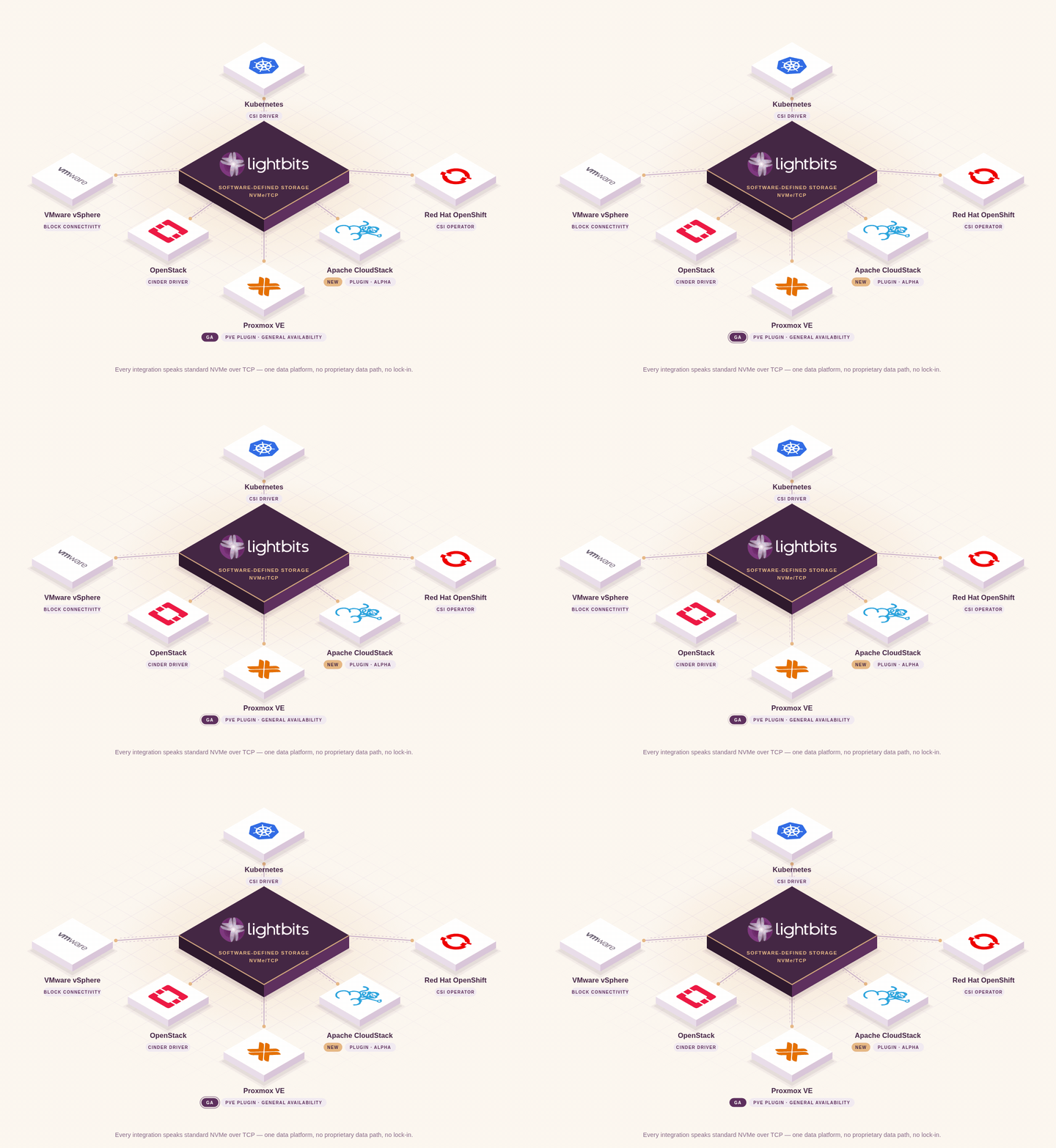
These two plugins join a long, steadily growing family of Lightbits platform integrations spanning VMware vSphere, Kubernetes with our CSI driver, Red Hat OpenShift, and OpenStack with our Cinder driver, all built on the same standard NVMe over TCP data path.
Read more: Lightbits for Proxmox VE · Proxmox VE plugin on GitHub · Lightbits for Apache CloudStack · Apache CloudStack plugin on GitHub
Resiliency and Monitoring Enhancements
Consistent with every Lightbits release, v3.21.1 continues to improve resiliency, with careful handling of rare edge cases and a broad set of quality-of-life improvements that keep an already-robust platform dependable and easier to operate day to day. Detailed descriptions of each improvement are available in the v3.21.1 release notes.
On the monitoring side, the Node dashboard adds a metadata utilization panel, SSD SMART alerts now tolerate a single missed scrape so that real hardware issues alert reliably, and log streaming returns a clear validation error when an rsyslog endpoint is entered in the wrong format.
Reminder – Certified for Red Hat OpenStack Services on OpenShift (RHOSO)
Lightbits was recently certified by Red Hat for Red Hat OpenStack Services on OpenShift (RHOSO), the next generation of Red Hat OpenStack, which runs the OpenStack control plane on OpenShift. With the certified Lightbits Cinder driver, RHOSO users get NVMe over TCP block storage for their virtual machines on standard servers and Ethernet networks, backed by an integration that Red Hat has tested and approved, a natural landing zone for teams moving off VMware. To learn what RHOSO is, how Lightbits integrates with it, and what the certification covers, watch our conversation with Sagy Volkov, Lightbits Field CTO, who drove the certification with Red Hat.
Red Hat Ecosystem Catalog: Lightbits Cinder Driver for RHOSO (Certified) · Watch: Lightbits and RHOSO Overview · Read more: RHOSO and Lightbits Storage · Lightbits Storage Integration with RHOSO 18
Looking Ahead
Lightbits v3.21.1 continues our commitment to delivering modern, efficient, and secure storage for performance-sensitive workloads across cloud, virtualization, AI infrastructure, and enterprise platforms, now with predictable and even more resilient recovery, production-ready eviction, and an even broader platform ecosystem. For full details, please refer to the v3.21.1 release notes and book time to talk with an expert if you would like guidance on planning spare capacity and recovery settings, evaluating the CloudStack plugin, or any of the new capabilities.
Looking further ahead, we are working on capabilities that will improve cost efficiency even more. With AI data centers absorbing memory supply and server DRAM prices climbing to record highs, RAM has become one of the most expensive parts of a storage server, and many customers are telling us the same: they need to keep growing capacity while bringing infrastructure costs down. We’re significantly reducing the memory footprint so Lightbits needs far less RAM for every terabyte of flash it manages, and we’re adding support for denser servers that pack more capacity into every rack unit. Together, these will lower the cost per terabyte and the data center footprint of every Lightbits cluster, with the same APIs and operational model our customers use today. Stay tuned for more details in upcoming releases.
Join us on the Lightbits User Community Hub to share your experiences and connect with our team.