

We are pleased to announce the availability of Lightbits v3.20.1, the newest release on our Standard-Term Support (STS) stream. This release significantly broadens where and how you can run Lightbits: it introduces support for Ubuntu 24.04 as the operating system for the storage cluster itself, a new guided installation experience, high-frequency per-volume latency monitoring, and a Proxmox plugin in Tech Preview, alongside expanded authentication options, richer Quality-of-Service controls, and a range of resiliency and monitoring improvements. As a leader in high-performance Software-Defined Storage built on NVMe over TCP block storage, Lightbits continues to deliver a modern, efficient, and scalable data platform for demanding AI training and inference, cloud service providers, e-commerce, financial, and enterprise workloads.
Ubuntu 24.04 Support: Run Your Lightbits Cluster on the OS You Standardize On
Lightbits storage clusters can now be deployed on Ubuntu 24.04 LTS, expanding the platform’s operating system options to one of the most widely adopted Linux distributions in cloud infrastructure. Ubuntu has long been a first-class citizen on the client side, where hosts connect to Lightbits volumes over standard NVMe over TCP; v3.20.1 completes the picture by bringing the storage cluster itself to Ubuntu, alongside the fully supported RHEL family. Many cloud service providers and enterprises build their infrastructure on Ubuntu, and they can now run the entire stack, clients and storage cluster alike, on the same operating system, tooling, and lifecycle processes they use everywhere else. This makes adopting Lightbits simpler than ever and a natural fit in even more environments.

Read more: Installing Lightbits on Ubuntu
Simplified Installation: A Guided Interactive Installer
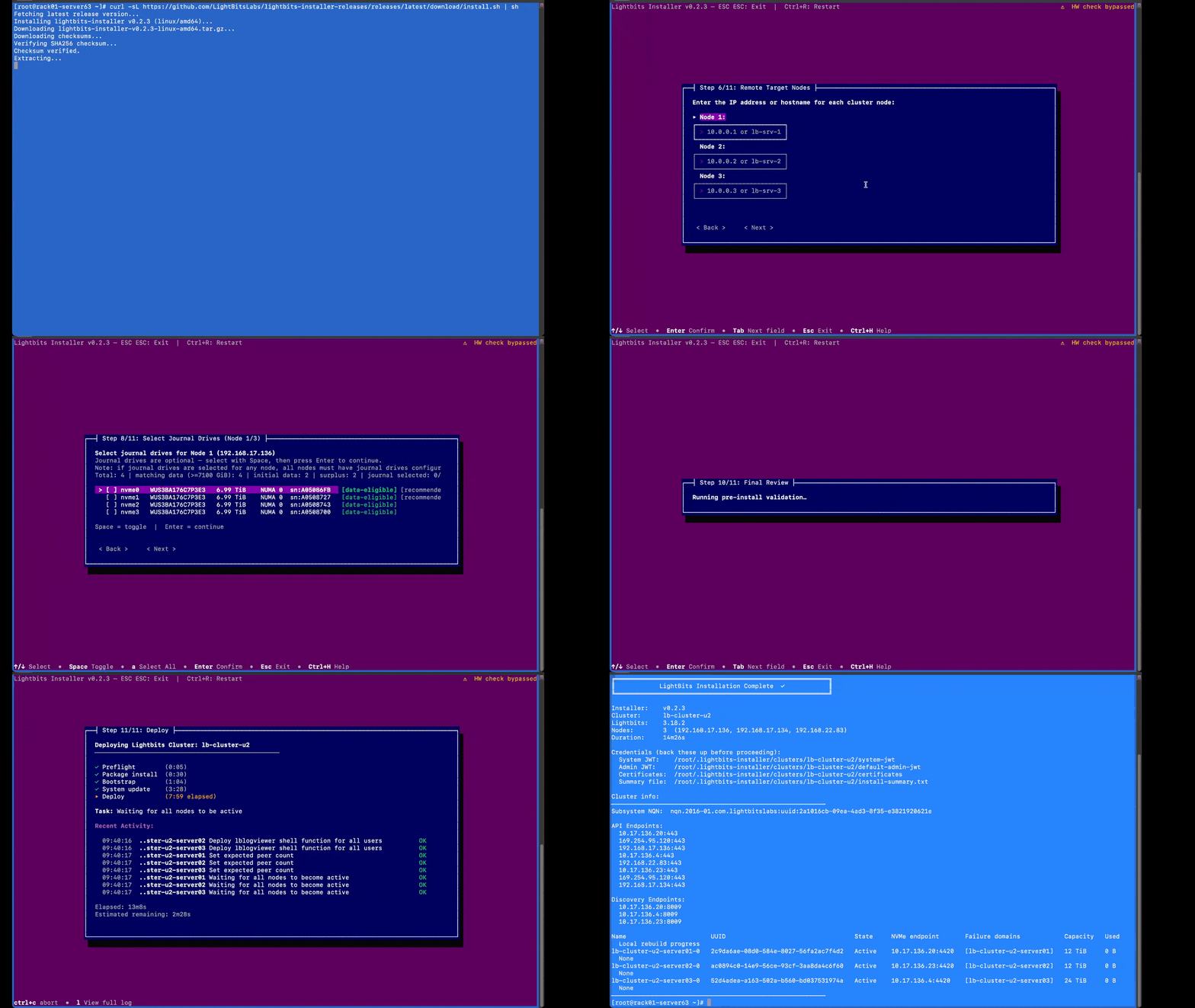
Deploying a Lightbits cluster is now dramatically simpler with the new interactive terminal-based installer (TUI). Instead of hand-editing Ansible configuration files, administrators are guided step by step through cluster deployment: the installer discovers and validates the environment with pre-deployment checks, proposes smart defaults for storage selection (including journal-aware drive reservation and auto-computed data-drive capacity), and surfaces real-time progress through each installation phase. Advanced settings remain available for fine-tuning, but a standard cluster can now be brought up with far fewer decisions, less specialized knowledge, and a much smaller chance of misconfiguration. This makes first-time evaluation faster and repeat deployments at scale more consistent.
Want to see for yourself? Getting the installer is a single command, supported on most Linux distributions and on macOS:
| curl -sL https://lightbitslabs.github.io/install.sh | sh |
Read more: Installing Lightbits with the Guided Installer
Performance Control and Visibility: For Cloud Service Providers, Neoclouds, and Beyond
v3.20.1 gives storage operators a matched pair of tools for running performance as a discipline: finer control over what each workload may consume, and sharper visibility into what it actually does. For cloud service providers and neoclouds, storage performance is not just something to manage; it is a product they sell: billing customers accurately and operating high-density multi-tenancy profitably both depend on explicit, enforceable performance meters and limits. Lightbits Quality-of-Service (QoS) rate-limiting policies can now express pure IOPS limits in addition to existing limit types, so providers can define precisely metered service tiers, bill against them with confidence, and pack more tenants onto shared infrastructure while keeping every workload within its allocation. On the monitoring side, new high-precision performance monitoring lets administrators enable fine-grained latency and I/O statistics on selected volumes at one-second resolution and explore them in a new high-precision Grafana dashboard featuring latency and I/O-size distribution histograms, heatmap visualizations, and multi-volume selection by name or ID; when a tenant reports a slow application, teams can zoom in on exactly the volumes involved and watch latency behavior as it happens, rather than working from coarse, cluster-wide averages. Together, these capabilities let operators set precise performance expectations and verify they are being met, with high-precision collection enabled per volume and bounded by configurable limits so the deep visibility comes without impacting cluster performance.

Okta Identity Provider Support
Lightbits v3.20.1 adds native integration with Okta as an external identity provider, extending the platform’s enterprise authentication options. This builds on the federated authentication foundation Lightbits established with Active Directory Federation Services (ADFS) integration, which lets organizations manage cluster access through their existing identity infrastructure rather than separate local users. With Okta now joining ADFS as a supported identity provider, administrators can authenticate to the cluster through lbcli and the REST API using their organization’s existing Okta identities, centralizing access control, simplifying credential lifecycle management, and aligning storage administration with corporate SSO and compliance policies, whichever identity platform their organization has standardized on.
Read more: Configuring Okta as an Identity Provider
Proxmox Plugin: Tech Preview
Virtualization teams evaluating alternatives to traditional hypervisor stacks are increasingly turning to Proxmox VE, and v3.20.1 brings a Lightbits Proxmox plugin as a Tech Preview. The plugin integrates Lightbits NVMe over TCP volumes as native Proxmox storage: Lightbits appears in the Proxmox storage tree, and VM disks are provisioned directly on a Lightbits cluster, benefiting from its performance, thin provisioning, and data services. The Tech Preview supports the core storage workflow end to end:
- VM disk provisioning and lifecycle: create, delete, and resize VM disks from the standard Proxmox UI or CLI, with online resize picked up by a running VM immediately
- Automatic volume connectivity: volumes are attached over NVMe over TCP when a VM starts and cleanly detached when it stops
- Snapshots and rollback: crash-consistent, point-in-time snapshots with near-instant server-side rollback, driven through the native qm snapshot / qm rollback commands
- Shared capacity pooling: all Proxmox nodes draw from the same Lightbits storage pool, with cluster capacity reported directly in the Proxmox dashboard
In this Tech Preview, the plugin operates as a system-wide integration with the Lightbits cluster, and additional tenant-level capabilities are on the way, bringing finer-grained isolation and per-tenant control to Proxmox environments.
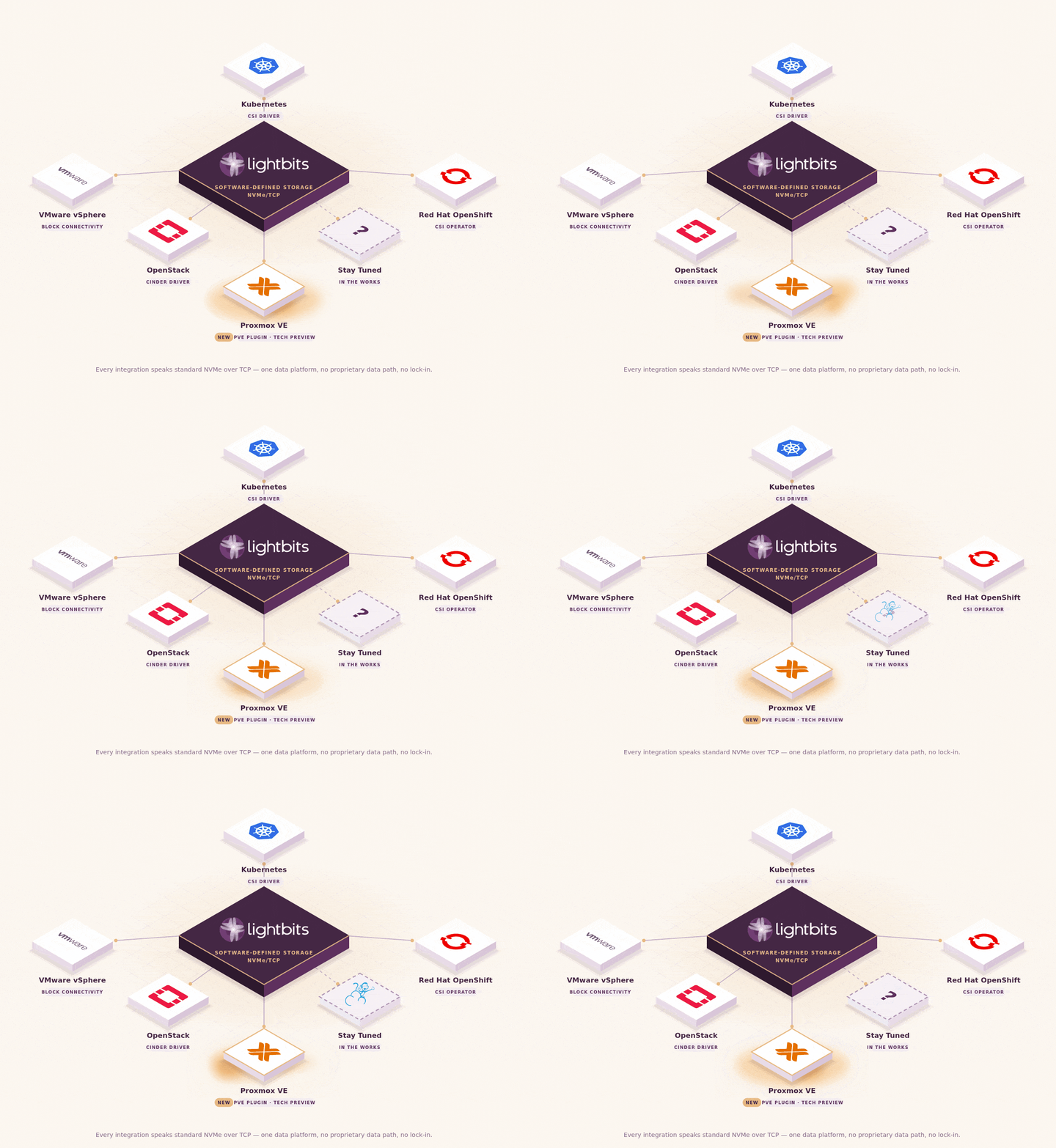
With this addition, Proxmox becomes the new kid on the block in a long and steadily growing family of Lightbits platform integrations. That family spans the virtualization mainstay with VMware vSphere, the container world with our Kubernetes CSI driver and Red Hat OpenShift support, and private clouds with the OpenStack Cinder driver, each built on the same standard NVMe over TCP data path. Proxmox VE is the newest member of that family, and it will not be the last: another platform integration is already in active development, and we look forward to sharing it in the very near future. We invite customers and partners exploring Proxmox to try the Tech Preview and share feedback with our team as we drive this integration toward general availability.
To learn more, watch the video: Lightbits × Proxmox VE — Deploying NVMe/TCP Block Storage, Start to Finish
Smoother Ecosystem Integrations
v3.20.1 also makes day-to-day integration with surrounding platforms easier. Building on the stringent REST request validation introduced in v3.19.1, a new configurable option allows the api-service to accept requests containing unrecognized fields, ignoring them safely rather than rejecting the request; the default remains strict, and the relaxed mode is recommended for environments running the vSphere/VCP integration or other external tooling that may send non-conforming fields.
Resiliency and Monitoring Enhancements
Consistent with every Lightbits release, v3.20.1 includes targeted resiliency work to help an already robust platform remain dependable under rare adverse conditions. Node recovery and rebuild have been strengthened against a rare timing condition between snapshot deletion and node recovery, with snapshots now cleaned up consistently across nodes so a stale snapshot can no longer cause a rebuild to fail. Journal device failure detection is more accurate, so a data-path failure caused by a non-journal issue is no longer misclassified as a journal device failure, preventing a node from being incorrectly marked as failed and eliminating spurious journal-device events when journaling is not in use. Detailed descriptions of each improvement are available in the v3.20.1 release notes.
On the monitoring side, the built-in syslog/log streaming capability introduced in v3.19.1 is now generally available and adds support for non-secured (plaintext) rsyslog targets alongside the existing mTLS-secured mode, broadening integration options for environments where the syslog collector sits on a trusted management network. To see what you can build with it, from Loki to your SIEM of choice, read our deep-dive blog post on open observability for NVMe over TCP storage.
Reminder – Choosing Your Stream: STS and LTS
v3.20.1 is a Standard-Term Support (STS) release. Both our STS and Long-Term Support (LTS) streams are fully production-ready; the difference lies in cadence and lifecycle, not production readiness. STS delivers the newest capabilities, like those in this release, sooner and at a faster cadence, while LTS arrives on a deliberately slower cadence with extended maintenance and support timeframes. If you are deciding which stream best fits your environment, we recommend reading Choosing the Right Lightbits Release: LTS vs STS Streams.
Looking Ahead
Lightbits v3.20.1 continues our commitment to delivering modern, efficient, and secure storage for performance-sensitive workloads across cloud, virtualization, AI infrastructure, and enterprise platforms, now with broader OS choice, a simpler path to deployment, and deeper performance visibility. For full details, please refer to the v3.20.1 release notes and book time to talk with an expert if you would like guidance on adopting Ubuntu, evaluating the Proxmox plugin, or any of the new capabilities.
Join us on the Lightbits User Community Hub to share your experiences and connect with our team.