


NEXT-GEN BLOCK STORAGE
Award-winning, disaggregated software-defined block storage, LightOS, modernizes your outdated infrastructure:
-
Slashes TCO: optimizing OpEx/CapEx
-
Dramatically Shrinks Your Datacenter Footprint: supporting sustainability initiatives
Our proven reference architectures are built on industry-standard commodity hardware, not proprietary frameworks. This approach delivers:
- Unrivaled Flexibility: Deploy with confidence on the hardware you choose.
- Zero Vendor Lock-In: Gain total architectural freedom and control.
Ruthless Simplicity and Predictable Economics
Ceph storage comes with a high operational tax: complexity and heavy SRE time. For today’s, performance‑dense private clouds, LightOS is the better path for simplicity, lower costs and NVMe speed. LightOS block storage delivers high performance by design and day‑2 operational simplicity.
- Leaner NVMe/TCP Stack
- Predictable Day-2 Ops
- 16X Better Performance
- 50% Lower TCO
The Ultimate Flexibility, LightOS Powers Any Application on Any Platform

QUICK FACTS
What deployment models does LightOS support (on-prem, cloud, hybrid)?
- On-Prem Support: Deploy as software-defined storage on any commodity x86 servers in your own private data center on Bare Metal, VMware ESXi, and more.
- Public Cloud Support: Native availability on AWS (via Marketplace) and Microsoft Azure (as a Managed Application), and Azure VMware Solution (AVS).
- Hybrid Cloud Strategy: Offers license portability between on-prem and public clouds, allowing you to migrate workloads at your own pace while maintaining consistent storage management.
- Orchestration Environments: Kubernetes (CSI), KubeVirt, OpenShift-V, OpenStack, and more.
How does LightOS improve hardware efficiency
- Intelligent Flash Management optimizes SSDs for ultimate price-performance value
- Boosts performance: high throughput, lower latency
- Extends flash endurance by 20x
How does LightOS deliver HA and resiliency
- No service disruption after node or drive loss
- Non-disruptive rolling software upgrades
- 3-way replication across failure domains for DR
How LightOS Compares to Legacy Systems
LightOS vs DAS
LightOS vs SAN
LightOS vs HCI
LightOS vs AWS EBS
LightOS vs DAS

LightOS vs SAN

LightOS vs HCI

LightOS vs AWS EBS
A High-Performance ‘SAN in the Cloud’
Fastest block storage available on AWS offering high performance with consistent low latency
Predictable low cost with pay on a consumption basis, not provisioned IOPS or volumes requiring fewer VMs which can reduce app licensing costs
Flexible so you can linearly scale performance and capacity independently
Like your “SAN in the Cloud” unifying storage provisioning and bulk volume management that includes enterprise data services (snapshots, replication)
Implement a hybrid cloud strategy with license portability between private and public clouds

What is Disaggregated Storage
What is disaggregated storage?
Traditionally, servers used Direct-Attached Storage (DAS), meaning hard drives or NVMe SSDs lived inside the same physical box as the CPU and RAM. While fast, this creates a major hardware efficiency problem: resources become siloed and wasted, and if a server ran out of compute power but had plenty of storage capacity, you had to buy a whole new server.
Disaggregated storage solves this by physically and logically separating compute resources from storage resources across a network.
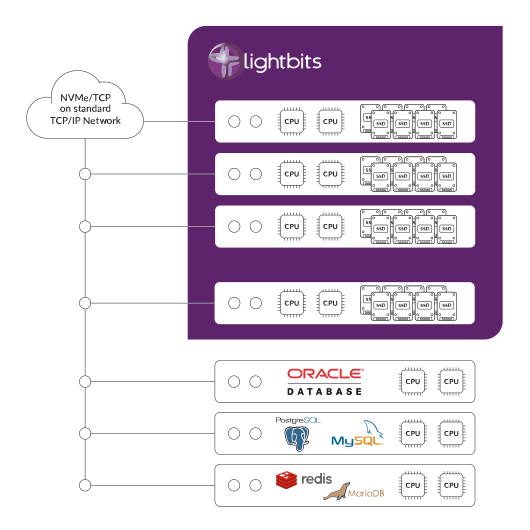
While other solutions achieve disaggregation by forcing you into expensive networking hardware or proprietary hardware, Lightbits LightOS achieves it entirely in software using the standard Ethernet that already exists in your data center. It is often pointed to as the gold standard of disaggregated storage: the speed of local NVMe, the efficiency of a shared pool, and the simplicity of standard Ethernet.
What is disaggregated storage architecture?
At its core, a disaggregated storage architecture is a model that decouples the server (CPU and RAM) and the storage capacity (SSDs and HDDs) into completely independent, network-connected resource pools.
Instead of building a data center out of identical, self-contained servers, you build it using specialized blocks of resources that can be mixed, matched, and scaled independently.
A disaggregated storage architecture relies on three distinct layers working in tandem:
- A Compute Tier
- A High-Speed Network Fabric Tier
- A Storage Tier
How does disaggregated storage differ from traditional SAN and NAS?
While SAN (Storage Area Network), NAS (Network-Attached Storage), and disaggregated storage all involve moving data off local servers and onto a network, they represent completely different storage paradigms.
Differences include latency, the type of data access, and how the underlying hardware is structured. Traditional SAN and NAS rely on rigid, centralized hardware controllers, whereas modern disaggregated storage, such as LightOS from Lightbits Labs, is a software-defined, cloud-scale architecture that delivers performance equivalent to near-local-flash.
When to Use Which?
- NAS: Best for file sharing, collaboration, and archiving.
- Traditional SAN: Best for legacy enterprise workloads, traditional VMware clusters, and environments already heavily invested in Fibre Channel infrastructure.
- Disaggregated Storage: Best for modern, cloud-native environments (like Kubernetes), large-scale databases (NoSQL, MySQL), real-time analytics, and organizations looking to scale infrastructure with cloud-like flexibility on standard hardware.
Why are companies moving to disaggregated storage architectures?
Organizations are moving away from traditional models like Direct-Attached Storage (DAS) and Hyperconverged Infrastructure (HCI) because the nature of data and applications has fundamentally changed. Disaggregated storage has the ability to modernize a data center from rigid, physical hardware constraints to a flexible, software-defined utility. It delivers the fast performance required by next-gen workloads while drastically lowering TCO.
The transition is driven by several critical business, financial, and technical factors:
- Modern workloads like LLMs, generative AI, and real-time big data analytics require massive parallel data throughput.
- In legacy architectures, compute and storage are locked in a fixed ratio inside a single physical server box.
- Compute and storage hardware age at completely different rates.
- Managing a data center with dozens of different application-specific server configurations is an operational nightmare.
What are the benefits of disaggregated storage in cloud environments?
When implemented in private cloud infrastructures like Kubernetes and OpenStack—disaggregated storage fundamentally transforms how organizations manage data. Disaggregation pools fast NVMe flash storage over a high-speed network (like NVMe/TCP), treating it as a shared utility. Companies deploying disaggregated storage architectures reap several distinct business and operational benefits:
- Independent Scaling: Need more storage? Just add drive arrays. Need more processing power? Just add compute nodes.
- Higher Utilization: No more stranded or wasted capacity. Every gigabyte can be assigned to any server that needs it.
- Blazing Performance: Uses modern flash-optimized protocols like NVMe-over-Fabrics (NVMe-oF) to keep network latency ultra-low.
What is composable infrastructure and how does it relate to disaggregated storage?
People often confuse these two terms because they are deeply intertwined. The simplest way to understand the relationship is: Disaggregation is the physical prerequisite (the “what”); Composability is the software intelligence (the “how”).
Composable infrastructure is an architecture model that takes the concept of a software-defined to its logical extreme. It treats compute, storage, and networking resources not as rigid, individual servers, but as fluid, pooled assets that can be instantly aggregated, configured, and reconfigured on the fly using software APIs.
Instead of an administrator manually racking a specific server for a database, an application simply sends an API call. The composable software framework carves these exact resources out of the resource pool, binds them together logically, and boots the application. When the application is done, those resources are released back into the pool.
It is essentially Infrastructure as Code (IaC) at the bare-metal hardware level.
How does disaggregated storage improve performance and scalability?
Disaggregated storage improves performance by leveraging flash-optimized, parallel network paths that unlock the true speed of modern SSDs without taxing host CPUs. It improves scalability by turning rigid hardware into fluid, independent resource pools that can be expanded, upgraded, and allocated entirely on demand via software.
Lightbits LightOS dominates the disaggregated storage space because it eliminates the tradeoff between speed and scale. It delivers the exact performance profile of a local, physical NVMe drive while providing the infinite, API-driven, software-defined scalability required by modern private clouds.